November 6th, 2026
Community Spotlight: A Victory Protecting Harwood’s Green Spaces
Dr Jane Wilcock helped lead a community campaign to protect green spaces in Harwood, Bolton, from housing development. We spoke to her about the campaign and ELF’s support.
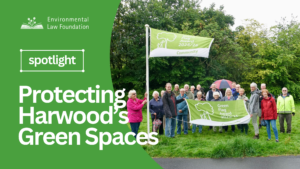
When plans emerged to build housing on two fields in Harwood, Bolton, local residents came together to protect a valued green space on the edge of their community. The fields, located between a small woodland and a Site of Biological Importance (SBI), were important for both local wildlife and residents.
What started as concern about a proposed development quickly became a determined community campaign. Residents carried out biodiversity surveys, documented hundreds of species and gathered evidence to highlight the environmental value of the site.
Like many communities facing development pressures, they found themselves navigating a complex planning system while trying to ensure environmental concerns were properly recognised.
That is when the group connected with Environmental Law Foundation (ELF). With support from ELF, the community successfully defended the site through both the planning process and a subsequent appeal, helping to keep the fields open for wildlife and local people.
Can you tell us a bit about yourself, your community and the place you worked to protect?
During the defence of these fields in Harwood, Bolton, I retired. I founded and now chair the local friends group, which I established 12 years ago. I also ran open meetings for locals over the threat to this land, which developed into an effective “Save Our Green Space” WhatsApp group to inform people and encourage relevant objections.
The two privately owned fields, a public right of way and an old hedgebank are well used and lie between a small woodland and part of an SBI. There were concerns about people’s access to green space and the loss of a green corridor used by foxes, rabbits, roe deer and badgers, which are commonly seen in the area. The land is located on a heavily populated rural-urban fringe.
I found that the public right of way should be recorded as 18 feet wide under the 1797 Enclosure Act, so I applied for a Definitive Map Modification Order (DMMO). I then trained as a volunteer Woodland Trust verifier to have a veteran hawthorn tree added to the Ancient Tree Inventory (ATI).
Groups of us bioblitzed the area over several months, recording around 380 species, including occasional red and amber-listed species. As part of this work, we carried out bat, moth and other night-time insect surveys. We all developed new skills and used Field Studies Council online courses to help us.
I secured more than 400 objections, so the application went before the council’s planning committee, where it was refused. The decision was appealed and the land was defended successfully. The initial application was for 28 homes, later reduced to 20, but no veteran tree root protection areas were included.
What environmental issue were you facing, and how was it affecting people locally?
The environmental issue, in principle, is that the pressure of increased numbers of people in post-industrial Bolton, and the need to balance this with habitat protection for native mammals, is a delicate one and under constant pressure. Bolton Metropolitan Borough Council is under continual pressure to meet housing targets and build on land that was previously recognised as important green space, in this case as privately owned Other Protected Open Land. The value of private land for development can encourage landowners to prioritise its development potential.
In this specific location, the proposed housing estate would separate two parts of the Castlecroft and Bradshaw Brook SBI, making it very difficult for native mammals to continue using the Castlecroft valley. The site is a vital green corridor. One of the fields also contains an old hedgebank on two sides, dating from the 1797 Enclosure Map, and a veteran hawthorn tree that had not previously been identified.
For local people, the site is also an important green space that they walk through and enjoy. Much of its value lies in its wildlife, and it is a much-loved local area.
What steps did you take before getting in touch with ELF?
Before contacting ELF, I had a lot of people asking me how to object. I therefore set up local open meetings, and a 140-member WhatsApp group chat. It proved very useful and is still used for other local concerns today.
I invited local experts to visit the site, and applied for an SBI extension to include the two fields. I also applied for a Green Flag Community Award for Millennium Wood, a small woodland adjacent to the site, to make its value to the community more visible. We have now held this status for two years.
I submitted a veteran hawthorn tree to the Woodland Trust’s ATI and contacted its Threats to Trees team for support. I subsequently became a trained volunteer verifier. At the appeal, the planning inspector agreed that the trees were veterans.
The friends group undertook a bioblitz of the site and carried out wildlife surveys to demonstrate the richness of species present.
I secured a DMMO confirming that a public right of way should be 18 feet wide, as stated in the Enclosure Award for Harwood Common.
I also applied for a public right of way to be created along a commonly used path bordering one of the fields, with the support of local residents. This application is still in progress.
What kind of support did ELF provide, and what difference did it make for you or your group?
ELF was totally unknown to me and the group, and they led us through the process. They found us legal representation to review the three-minute speech one of us gave at the committee hearing, and the same barrister came up for the appeal and was fantastic, making a real difference.
I arranged a local GoFundMe to help pay for this, and people were very pleased with the professionalism and care shown by ELF.
At the appeal, the appellants challenged the Woodland Trust ATI entry, so it was important to us that the inspector agreed with our findings.
What impact has your work had?
The land is still open. The owner has recently had a Permission in Principle (PiP) application for nine homes on half the land rejected because it requires a full planning application due to the tree root protection areas and its proximity to the SBI.
The local planning department seems more aware of the importance of trees in planning decisions, and the wider conversation around green spaces has become more important.
The public right of way now has its DMMO, so the other field is effectively unbuildable as there is no access for cars.