March 30th, 2026
Pollution on the rise: What we’re seeing across our casework
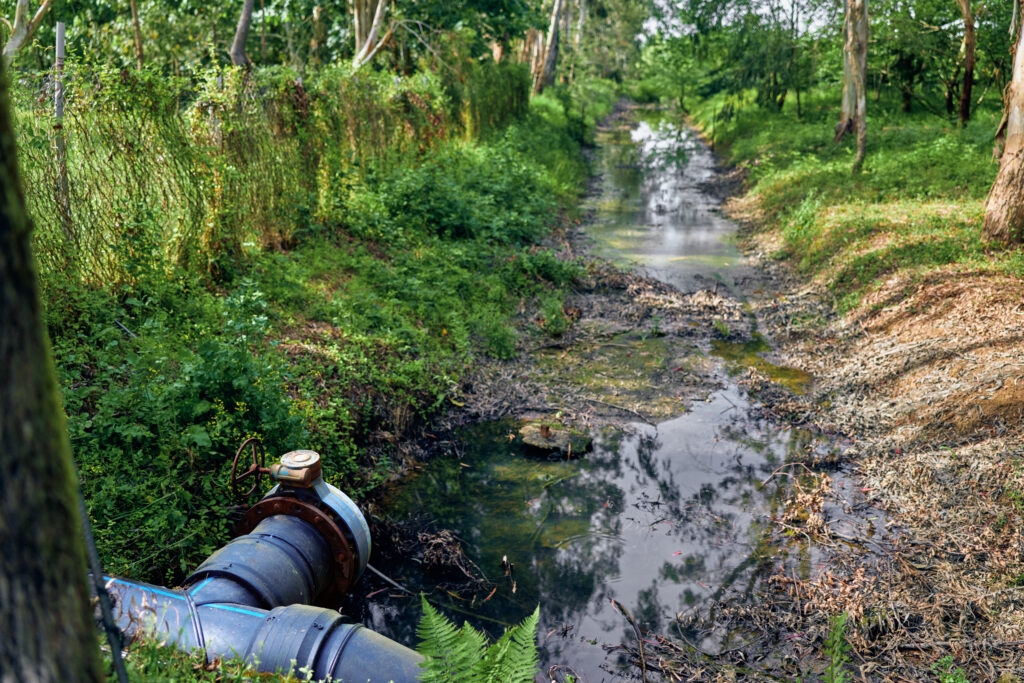
Polluted water in stream from pipe drainage affecting river and surrounding nature with trees, muddy water and debris, environmental contamination and wetland vegetation along banks.
Over the past year, we have seen a marked increase in the number of communities coming to the Environmental Law Foundation for support on pollution and contamination issues. Out of 381 enquiries received in 2025, at least 237 involved pollution, toxics, or chemical exposure as the central issue or an environmental factor in a wider concern, underlining just how central these issues have become to the environmental concerns facing communities across the UK.
These cases span a wide range of issues. Water pollution remains a key concern, including sewage discharges, agricultural runoff, and chemical contamination of rivers. But we are also seeing increasing numbers of cases involving air pollution linked to major developments, industrial farming emissions, and waste operations both legal and illegal, as well as land contamination arising from historic industrial activity or failures to properly remediate sites.
Recent investigations and media attention, including Channel 4’s Dirty Business, have brought renewed attention to the scale of the UK’s sewage pollution crisis and the systemic failures that have allowed it to persist. Our casework reflects this wider reality: pollution is rarely isolated, and communities are often dealing with multiple, overlapping environmental risks, without the resources or access to legal expertise needed to respond.
Across our work, we are supporting communities facing a wide range of pollution-related harms affecting both public health and protected environments. For example, we are advising residents in an ongoing concern about illegal waste processing and toxic emissions at a large-scale farm, where unregulated waste burning and shredding is releasing harmful particulates, including microplastics, near a Site of Special Scientific Interest. In Wales, we are assisting communities following a formaldehyde leak into the River Alyn, which resulted in a significant fish kill and raised serious concerns about regulatory compliance at a nearby chemical plant.
We are also supporting residents in an issue where land previously used as a WWII aircraft scrapping site may contain radioactive contamination that was never properly remediated, raising ongoing risks to public health. Elsewhere, we are advising campaigners opposing the proposed expansion of a Quarry, where concerns include dust pollution, particulate exposure, and the impact on nearby protected habitats.
These examples are only a snapshot of the cases we are seeing. Across the UK, communities are increasingly encountering pollution in different forms, often linked to broader pressures such as development, infrastructure, and industrial activity.
As these pressures grow, so too does the need for communities to be able to understand and use the law to protect the places they live. Enforcement by the regulators cannot be relied upon and communities are left to seek redress themselves. Ensuring access to legal support is not just about resolving individual cases, but about strengthening environmental protection more broadly.