February 19th, 2026
Member Spotlight: Duncan Sinclair
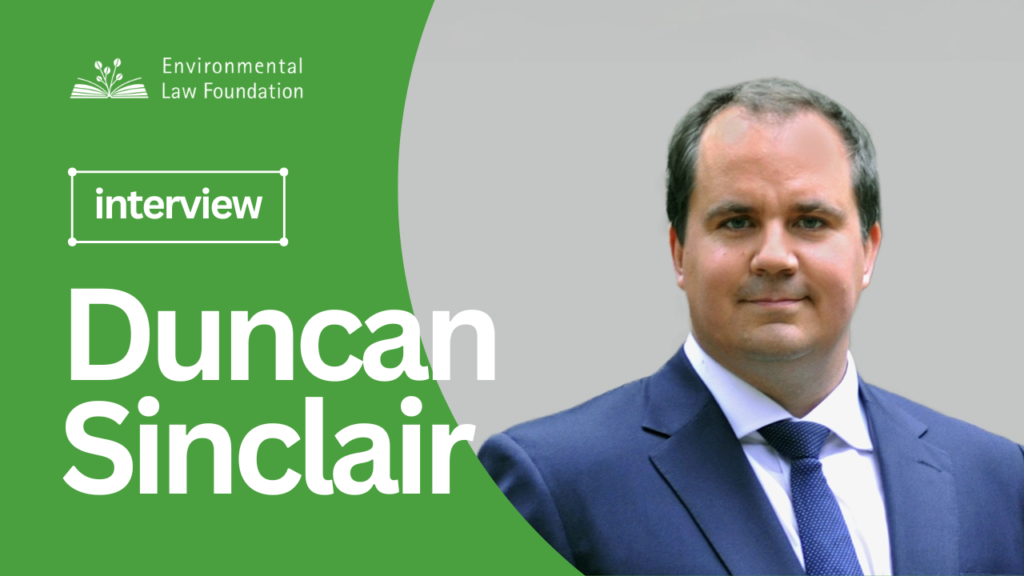
Duncan is a barrister at 39 Essex Chambers, having returned to the Bar after 5 years as co-head of legal at the energy regulator Ofgem from 2005-10. He has a particular focus on (former) EU law issues including procurement and state aid (now the Subsidy Control Act), on GB/EU energy regulation, and on planning law.
Can you tell us about your background and what inspired you to specialize in environmental law?
I had a peripatetic start to life, growing up initially in Fiji and then in New Zealand and Hong Kong, before coming to the UK for the last part of my secondary education and studying law at Cambridge University, with part of my family remaining in Hong Kong. Presumably that makes me either a “citizen of nowhere,” if one accepts the premise behind Theresa May’s categorisation, particularly as I later worked for several years in Brussels, or a “citizen of the world”—or, less pretentiously, someone with a less parochial view of the world. No prizes for guessing which description I would prefer if I had to choose.
It is probably for that reason that I have always been engaged in global issues, and within the legal sphere environmental issues are particularly important and interesting. Environmental legal issues can stem from something that may appear relatively local, such as a planning decision which may affect the local environment but also increase greenhouse gas emissions, as with “energy from waste” plants, more accurately known as incinerators. Or they can stem from, or involve, more fundamentally international legal issues, from the Aarhus Convention to other international rules or national targets based on international agreements.
There is also a natural fit with broader sectoral or substantive areas of law I had been practising, including energy regulation, which had only fairly recently begun to include the need to reduce greenhouse gas emissions in Ofgem’s principal objectives when I joined, and the capturing of the negative externalities incurred by fossil fuels.
So it is an area that ticks all the boxes, particularly as it can be used for the public good, and several cases I have worked on with ELF have been undertaken on a pro bono basis.
What motivated you to join ELF?
I first learnt about ELF from colleagues in chambers, and after working with Emma Montlake on my first case, I was hooked. It is something I return to as and when I can.
How has working with the Environmental Law Foundation influenced your career and professional development?
ELF has been important to me personally in being able to take on work that I wanted to do and which had a clear public benefit.
Can you share a memorable case or project you worked on through ELF that had a significant impact on the community or the environment?
Perhaps this example is more a case of the one that got away, though the precedent set and ramifications for local government continue to play out. As it involved so many issues and had practical effects, I have chosen this one.
In Community 4RC v Gloucestershire County Council, I acted for a public interest group aiming to prevent the award of the largest contract to date by GCC to a consortium to build a waste incinerator. This had already been challenged at the planning stage; I took it on as a procurement and state aid case, with some ancillary angles. This form of waste disposal was only marginally above landfill in terms of the waste hierarchy, and our challenge proceeded on the basis of a breach of the Public Contracts Regulations, that is, procurement law.
It was ultimately disclosed, and accepted by the High Court, that the majority of the GCC Board had hidden a substantial increase in costs negotiated without any competition for some two years, having succeeded on timing, as a claim had to be commenced within months of actual or implied knowledge.
Whilst the public interest group was found not to have sufficient standing, essentially on a highly technical argument, to proceed further with the challenge, the case was reported on BBC News and in several broadsheets. The resulting publicity and press coverage led to local ramifications, including following a change in the composition of the Council, and should serve as a potent reminder for other local authorities. The GCC auditors were even brought in and commenced a public interest audit based on complaints by local constituents, including C4RC members.
In your opinion, why should other legal professionals consider joining the Environmental Law Foundation, and what advice would you give to those who are interested in pursuing a career in environmental law?
If you have an interest in environmental law, there is every reason to join ELF, from networking and camaraderie to undertaking work, whether pro bono or ultimately paid, in your area of interest.
Nor do you need to be a complete specialist in environmental law. As environmental legal issues arise in so many contexts, you may be able to put what you might not consider a relevant specialism to good purpose. For instance, in the example above, the dispute involved planning law, procurement law, the use of auditors to conduct an investigation upon complaint by local taxpayers, a complaint to the CMA for abuse of dominance, and consideration of a state aid complaint involving engagement with the EU Commission in Brussels; the latter had to be discontinued because of Brexit and because the Subsidy Control Act had not yet been passed.
There are cases where the result in court is positive and therefore a cause for celebration. There are other cases where, even if the court result sought is not obtained, the pressure and scrutiny brought to bear on those taking decisions will have a longer-term impact.