September 12th, 2024
ELF member spotlight: Sue Willman
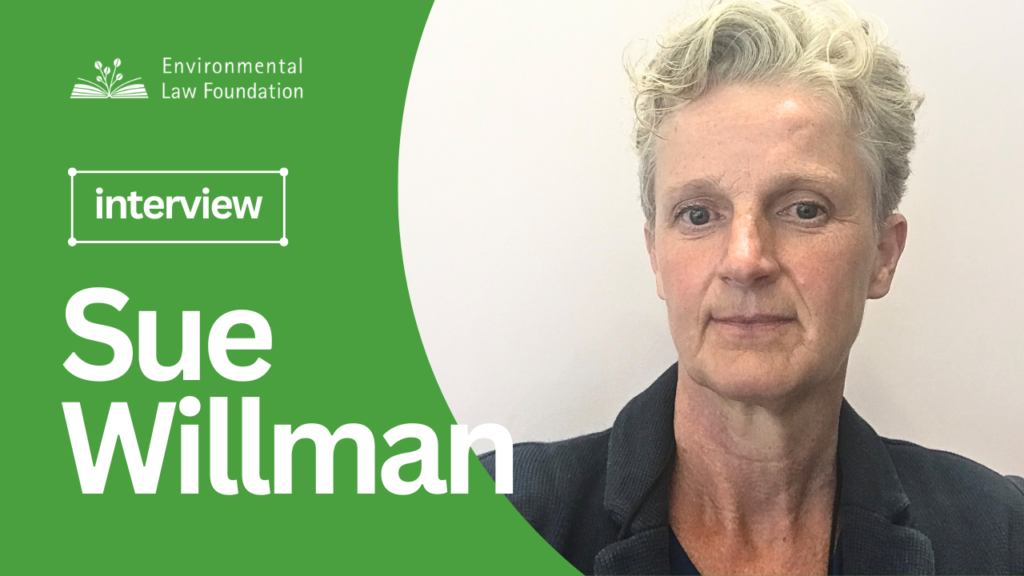
Sue is a senior consultant solicitor at public interest legal aid firm Deighton PIerce Glynn DPG law – UK civil rights and judicial review litigation firm. There she has acted in planning and environmental law judicial reviews, such as the recent JR of the UK government’s decision to convert the use of a military base for housing of asylum-seekers. She is an Assistant Director and Lecturer at the King’s College, Legal Clinic, London where she has launched the UK’s only human rights and environment legal clinic Human Rights and Environment Clinic | King’s Legal Clinic | King’s College London (kcl.ac.uk) and is a member of the Climate Law and Governance Centre. She supervises students on mostly climate related cases in the UK and the global south, for example an amicus re deforestation in Uganda. She works closely with ELF accepting referrals on domestic cases such as methane pollution caused by the Singleton oilfield in the South Downs. She co-founded the Environmental Rights Recognition Project, with Harry Balfour-Lynn which has produced a series of briefings on the right to a healthy environment. She has a particular interest in Rights of Nature approaches and rivers and has co-produced A Rights of Nature Toolkit on rivers. She is a member of the Climate Change Working Group of the Law Society of England and Wales.
Can you tell us about your background and what inspired you to specialize in environmental law?
I was brought up in a village called Ivybridge on the southern edge of Dartmoor, so I have always felt close to nature and the River Erme which ran through it. I studied law because I was interested in social justice but in the 1980s, environmental law wasn’t really a thing. From 2008, I visited Colombia as part of the Colombia Caravana human rights lawyers delegation and saw the devastation caused to nature and to indigenous and Afro-Colombian communities by multinational mining companies. That inspired me to link my human rights law practice with environmental litigation.
What motivated you to join ELF?
I joined back in 2011 so it’s hard to remember. At the time I was involved in legal advice to Mark Snow, a protester trying to stop the felling of the 100 year old Irton beech in Yorkshire. Then I met Tom Brenan at a Wild Law weekend in the South Downs. I was soon delivering training to ELF volunteers and I’ve been working with ELF on and off ever since.
Can you share a memorable case or project you worked on through ELF that had a significant impact on the community or the environment?
ELF introduced me to Theo Thomas of the London Waterkeeper in about 2016 when I was a partner at Deighton Pierce Glynn. We advised on how to use FOIA and EIR requests to highlight stormwater overflows, with some advice from David Wolfe at Matrix Chambers. That informed a successful campaign by London Waterkeeper – Defending rivers. Challenging polluters. to compel Thames Water to change its approach. I reached out to Theo again when I launched a [http://Human Rights and Environment Clinic | King’s Legal Clinic | King’s College London (kcl.ac.uk)]Human Rights and Environment Legal Clinic[http://Human Rights and Environment Clinic | King’s Legal Clinic | King’s College London (kcl.ac.uk)] at King’s College and he has collaborated on the ongoing work to defend rivers from a Rights of nature perspective using the rights-of-nature-toolkit.pdf (kcl.ac.uk).
What are some of the unique opportunities or advantages you’ve experienced as a member of ELF compared to other professional networks or organisations?
It is challenging to practice environmental law from a Claimant and activist perspective because resources are in the hands of developers, and to a lesser extent public bodies. ELF offers support to those of us who are aiming to approach it from a community-based approach. Importantly, ELF has always been ready to focus on an ecocentric Rights of Nature perspective, even when that seemed like a revolutionary and somewhat crazy idea.
In your opinion, why should other legal professionals consider joining the Environmental Law Foundation, and what advice would you give to those who are interested in pursuing a career in environmental law?
It’s easy to be overwhelmed and give up when faced with the climate and nature emergency. But there are more opportunities than ever before so with a little resilience it’s achievable. Try to find an aspect of environmental law that you are interested in and develop a niche. For me that has become rivers and Rights of Nature. But it could equally be birds, forests, a just transition, AI, energy, climate finance etc. etc. Whether a student volunteer, a Claimant solicitor, or a barrister / corporate lawyer, ELF offers us all a chance to keep informed and to support the defence of the environment in numerous ways from sharing experience, writing a newsletter piece, offering training, or a donation.