January 9th, 2025
ELF Member Spotlight: Lisa Foster
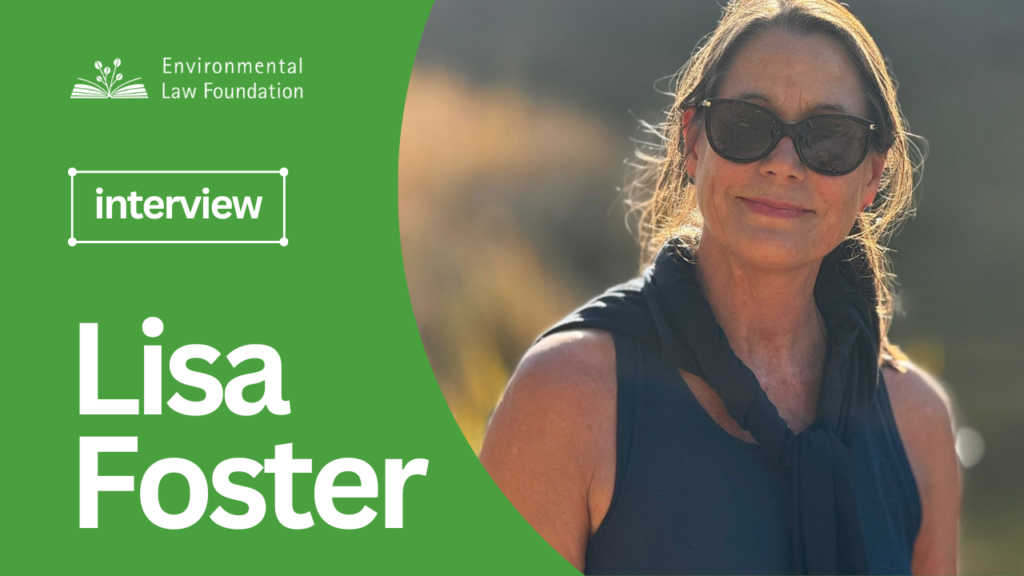
Lisa has worked for Richard Buxton since May 2008 and became a partner in October 2014.
She divides her practice between planning and environmental protection cases. On the planning side she has long experience in successfully representing Parish and Town Councils, individuals and community groups opposed to inappropriate housing and other development in their neighbourhoods and protected areas like Areas of Outstanding Natural Beauty, National Parks and in proximity to ecologically sensitive areas. She has expertise in opposing development harmful to the historic environment. She drafts planning objections to oppose development when at the planning committee or appeal stage before court proceedings.
Lisa qualified as a lawyer in California in 1985 and worked as a trial lawyer gaining experience as an advocate in California State and Federal court proceedings representing parties in civil and criminal cases. She holds practicing certificates in England and Wales and with the California Bar Association.
In 1992 she was awarded a Masters in Building Conservation Studies from the University of York. In 1993 she was awarded fellowship funding from ICOMOS (International Council of Monuments) to write a guidance note for English Heritage on access to historic buildings.
In 2008 she was awarded an MSc with distinction from University of East Anglia at graduation. Her dissertation looked at the Environment Agency’s application of EU laws (the Strategic Environmental Assessment Directive) to coastal flood risk assessment and management.
Can you tell us about your background and what inspired you to specialise in environmental law?
I trained and worked as a lawyer in California and then took a break from law and studied for a Masters in Building Conservation at the University of York 1992-1993. After several years working for what was then English Heritage and other large institutions advising on public access to buildings in a non-legal capacity I wanted to return to the practice of law and could see that environmental issues were an important area of work that interested me. So I returned to university (again) and did a MSc at the University of East Anglia in Environmental assessment and management – that led to Richard Buxton’s door and I started back working in the legal field in 2008 as an associate in the firm. I became a partner in 2014. Although not a straight line career, the work I do now in environmental and planning cases it fits with my wider interest in conservation of the built and natural environment.
What motivated you to join ELF?
We have a corporate membership to support ELF’s work and its good to be on the end of phone when ELF has questions or concerns.
How has working with the Environmental Law Foundation influenced your career and professional development?
The work we do is to take up new matters which initiate with ELF and run cases hopefully to a successful outcome.
Can you share a memorable case or project you worked on through ELF that had a significant impact on the community or the environment?
In 2021 we won a case that came in the door from ELF related to unlawful suspension of experimental traffic measures in Poole put in place by the Council through an Experimental Traffic Order under the Road Traffic Regulation Act 1984 to reduce vehicle road traffic into Poole park in favour of cyclist and walkers. The case was R(Keyhole Bridge User Safety Group) v BCP Council. It was brought on behalf a resident’s group and was a legal challenge to the early suspension of temporary road measures put in place under the ETO. Counsel for the Claimant was Piers Riley-Smith of Kings Chambers. The Judge concluded that the Council breached its informal commitments by early curtailment of the timeframes set out in consultation documents. In deciding on remedy, the Court ordered that to remedy the unfairness and unlawfulness there should be further non-statutory consultation and then the Council had to conduct a review of its decision to suspend the ETO.The judge also ordered a significant payment toward the Claimant’s legal costs.
We acted for Peter Steer in the Kedleston Hall case legal challenge that redefined how to consider the setting of historic buildings – this was another ELF referral. In the case the Court of Appeal confirmed that the setting of heritage assets “is not necessarily confined to visual or physical impact” but that other considerations are potentially relevant. This includes the surroundings in which the heritage asset is experienced, keeping in mind that those “surroundings” may change over time, and also that the way in which a heritage asset can be “experienced” is not limited only to the sense of sight.
What are some of the unique opportunities or advantages you’ve experienced as a member of ELF compared to other professional networks or organisations?
We have access to a wide range of information and experience and get to work alongside good committed public law barristers.
In your opinion, why should other legal professionals consider joining the Environmental Law Foundation, and what advice would you give to those who are interested in pursuing a career in environmental law?
There are many very interesting areas of law – but the work we do can lead to a measurable difference to local communities who want to fight to protect their built or natural environment. The ability of local residents to contact a solicitor through ELF and be guided through planning objection process or the court JR process provides access to justice in circumstances where that might not happen due to funding or simply not knowing where to go. By joining ELF others can be part of that support for local communities.