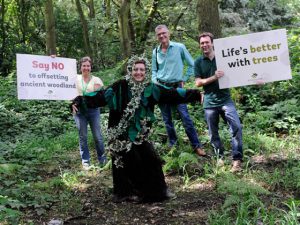
A Case Study of the Successful Campaign to Stop the Red Route and Shift Welsh Policy Towards More Environmentally Conscious Priorities
Introduction
The cancellation of the Red Route project in Flintshire, Wales has been welcomed by many and provides a strong example of the power of public pressure and community activism in protecting local environments. Through the mobilization of their members and supporters, North Wales Wildlife Trust (NWWT) and Stamp Out The Red Route were able to influence the Welsh Government’s decision-making to put the environment first. The success of their campaign also highlights the importance of resilience and perseverance in the face of seemingly insurmountable obstacles.
The Red Route Proposal
The proposed Red Route which aimed to alleviate congestion but would have caused severe damage to ancient Welsh woodlands, local farmlands, and native habitats. This damage would have been felt for decades to come, and the cost immeasurable. Despite this, alternative options such as the use of public transport, staggered start times for commuters, and building cycle lanes had not been explored.
Mobilization and Campaigning
NWWT and Stamp Out the Red Route rightly felt that these alternative options would cause far less damage to the environment and be easier to implement. The Red Route would have caused native species to lose access to their nesting grounds, and the introduction of traffic to a previously wild location would have brought about the possibility of road deaths for rabbits, foxes, badgers, and other native wildlife.
The campaign to prevent the development of the Red Route road began in 2017 when the NWWT and several local campaign groups launched objections to the local council. These objections not only revealed miscalculations on the cost of the proposed route, but also the lack of consultation with local people who would be adversely affected by the introduction of such a road. In 2020, NWWT connected with the Environmental Law Foundation (ELF), which, along with Sioned Davies, provided regular consultation to NWWT and Stamp Out The Red Route as they fought for the protection of their local environment.
Significance of the Campaign
For some, the success of the Red Route campaign is seen as a call-to-action to support other environmental movements , and to use their skills, resources and knowledge to protect habitats, species and landscapes from degradation. Going forward, campaigners hope to use the example of the Red Route to encourage a more sustainable approach to transport and infrastructure planning, and to reduce their negative impacts on the environment.
Outcomes and Implications
The cancellation of the Red Route project is a sign of progress, in many respects. It is a win for the environment, a success for the communities of Flintshire, and a reaffirmation of the importance of public community activism in protecting local habitats and ecosystems. In addition, the Welsh Government’s decision to halt construction sends a strong message to the rest of the UK that Wales will no longer accept proposals that are damaging to the environment, and that their commitment to protecting nature is stronger than ever.
The Red Route campaign has also inspired and invigorated activists across Wales to work together towards achieving more sustainable development, and towards creating a more equitable and environmentally conscious future. It is essential that we act on the lessons of this successful campaign, and continue to fight for environmental conservation and justice. This case study shows us the importance of community engagement and activism in achieving positive outcomes in the face of challenging odds.
Looking Forward
The success of the Red Route campaign should serve as a model for activists in Wales and beyond. It demonstrates that with collective action and strong leadership we can drive change that benefits both people and the environment. We must build on the success of this example and continue to fight for environmental conservation and justice. Calls for decision-makers to be held accountable for their actions, and for a demand for more environmentally conscious policies, must be kept alive in Wales, and across the UK.
The Red Route campaign is an important example of how public pressure can be leveraged to achieve positive outcomes, even in the face of daunting odds. Every community and organization involved in the campaign should be commended for their work and commitment. Ultimately, the Red Route campaign is a powerful testament to the power of collective action and community activism in protecting local environments and fighting for environmental justice. Going forward, this should serve as an inspiration to all those working for a more sustainable and equitable future.
Consider donating to help us continue fighting for environmental rights
The work that we do is powered by people like you. If you’d like to support us, as we help grassroots organisations fight for environemental justice, you can do so by donating here.

ELF has been helping volunteer group Better Streets for Kensington and Chelsea (Better Streets) in their campaign to re-instate a safe cycle lane on High Street Kensington, located in the Royal Borough of Kensington and Chelsea (RBKC) in London.
Installation of safe infrastructure for those wishing to travel by bike has become a national discussion, with some describing it as a “war on motorists”. That’s certainly not the context in RBKC. Prior to the lane’s removal, and during its short life, it was the only safe protected cycle lane on the entirety of the borough’s 207km road network where since 2013 the amount of vehicle traffic has increased by 50 million miles per year.
RBKC is infamous among campaigners for walking and cycling for its lack of action over decades, including on High Street Kensington where plans have been tabled many times over the years as it is part of the overall London strategic network, and neighbouring boroughs are completing their part.
The lanes were installed in October, 2020 for a trial of up to 18 months, but ripped out after just seven weeks, despite the lanes working very well. ELF wrote a pre-action protocol letter of 23rd December set out seven grounds of unlawfulness of RBKC’s decision.
This challenge was successful, and on 8th January, RBKC wrote to Better Streets to say they would “revisit” the decision to remove the lane on 17th March – when, as predicted, they made the same decision, but attempted to get the paperwork better.
ELF and Better Streets are considering next steps – at first glance it doesn’t look like this decision is any more lawful than the last. The lanes are supported by a huge cross-section of society, from Waitrose to the Royal Albert Hall, to the local NHS Trusts, seventeen local schools, universities Imperial College London and the Royal College of Music – as well as a survey commissioned by TfL showing most residents are also in favour.

Gwent Levels, saved for now
The decision by the Welsh First Minister to refuse the M4 relief road proposals, which would have destroyed the unique and historic Gwent Levels, feels like a historic decision where nature has been put before economic development.
ELF has played a part in this historic decision and we would like to thank all those barristers, who through the ELF network gave so generously with their time – Charles Streeten of FTB, Grace Brown and Irena Sabic of Garden Court Chambers, Alastair Henderson, Hannah Noyce and Dominic Ruck-Keene of 1 Crown Office Row.
Anyone who cares about nature can’t have missed the amazing news that following a year-long Public Inquiry into the proposed M4 relief road, the decision of the First Welsh Minister to refuse permission to the project, means that the historic Gwent Levels are saved.
Mark Drakeford, First Minister of Wales, stated:- I attach greater weight than the inspector to the adverse impacts that the project would have on the environment and ecology. In particular, I attach very significant weight to the fact that the project would have a substantial adverse impact on the Gwent levels sites of special scientific interest and their green network and wildlife, and on other species, and a permanent adverse impact on the historic landscape of the Gwent levels. As a result, in my judgment, the project’s adverse impacts on the environment, taken together with other disadvantages, outweigh its advantages.
ELF has played a part in this historic decision and we would like to thank all those barristers, who through the ELF network gave so generously – James Byrne of the Welsh Wildlife Trust who had coordinated much of the environmental objections, came to ELF two years ago looking for support. ELF reached out to the ELF membership and was able to secure advocacy support from Charles Streeten of FTB, Grace Brown and Irena Sabic of Garden Court Chambers and Alastair Henderson, Hannah Noyce and Dominic Ruck-Keene of 1 Crown Office Row. Each of these barristers gave their time with great generosity and ELF would like to thank them all.
The Inspectors report highlighted….
2.35 Gwent Wildlife Trust is a statutory objector whose land would be subject to the CPO but they made no application to the Inspectors for a direction in respect of either funding or appointment of Counsel. They were ably assisted and represented by an impressive team of Counsel who had volunteered their services.

Photo showing scale of building, permission issued without amenity conditions threatened the residents
A matter that started with ELF has been successful in a Judicial Review claim, despite being a year since the decision. This is an eminently just decision for local residents and ELF would like to thank ELF members Horatio Waller and Ian Graves and congratulate them on a good result for the local community in Milton Keynes.
In December of 2018 ELF was approached by two separate individuals on the same matter. Local people in Milton Keynes had discovered that the permission for the enormous new industrial building being built meters from their bungalow homes did not have any of the amenity conditions, as should have been attached to the permission. Awareness of this had first come to light when trees that residents had thought protected, were felled. On reviewing the planning permission it was revealed that all 13 amenity conditions were missing. A sorry situation for local residents as conditions related to landscaping, light and noise were imposed to protect the amenity of neighbouring residents. As we were now over a year since the decision notice had been issued, the question was could we still JR the original decision?
ELF approached Ian Graves, ELF solicitor member at Shakespeare Martineau and Horatio Waller at FTB. Both agreed to undertake the matter under a CFA.
Horatio Waller explains more fully. https://www.ftbchambers.co.uk/news/success-judicial-review-claim-issued-1-year-out-time
“It emerged after JR was issued that the developer and junior officers of the Council had discovered the mistake soon after the notice was issued, but residents and senior planning officers were kept in the dark for several months. When senior officers discovered the mistake they attempted to rectify the error by encouraging a second application for identical development, subject to a unilateral undertaking revoking the first permission.
Permission on a second application was approved by the DCC, but a decision notice was never issued. The reason why became public knowledge only after JR was issued. The developer had attempted to persuade the Council to drop one of the conditions on the first permission, which controlled access to the site by heavy goods vehicles (HGV), in return for it implementing a second identical permission that included the missing conditions.
This was unacceptable to the Council and the arrangement fell through. The Council then decided to impose a s102 order imposing controls on lighting, but not controlling other matters addressed by the missing conditions. This was only a partial solution, so Mrs Wardlaw issued JR out-of-time to challenge the planning permission. By the time JR was issued, over a year had expired since planning permission was granted and the development was almost complete.
The deadline for issuing JR of a grant of planning permission is six weeks, but the Court has a power under CPR 3.1(2)(a) to extend the time limit which can be sought after the expiry of the six week period. Mrs Wardlaw sought permission to issue JR out-of-time, arguing that there were “very special reasons” why the Court should do so citing Sales LJ’s judgment in Gerber v Wiltshire Council [2016] 1 WLR 547 at [49].
Reliance was also placed on the High Court decision in Thornton Hall Hotel Ltd v Wirral WBC [2018] PTSR 94 where a judicial review claim against a grant of planning permission was allowed notwithstanding that it had been brought five years out-of-time. In that case the planning permission had erroneously omitted conditions specified by the planning committee, including a five-year time limit on the permission, and the claimant had issued the claim with reasonable speed on becoming aware of the mistake. The judgment was recently upheld on appeal ([2019] EWCA Civ 737).
The Wardlaw JR settled after the developer and Council agreed to revisit the proposal of promoting a second application for identical development on the site. The developer dropped its stance that no HGV condition should be imposed and gave a unilateral undertaking that it would cease implementing the first permission and implement the second permission. Planning permission was subsequently granted.
This settlement meant that Mrs Wardlaw could discontinue her claim because the underlying issues had been resolved and the Council had agreed to pay her costs.”
This is the best result the community could have hoped for. There has been subsequent disquiet from local councillors that this building, so out of scale with local homes, was recommended for approval in the first place. At least now, thanks to a great legal team, the community have the protections that they expected.
Otmoor Nature Reserve lies within the chosen corridor B
In June ELF was approached by the Horton-cum-Studley Expressway Group (“the group”), established in response to local communities becoming aware of plans for a proposed major road build linking Oxford and Cambridge. The Oxford to Cambridge Expressway is a large road building proposal (requiring a Development Consent Order (DCO)) connecting the two cities east to west and would enable the delivery of 1 million new homes to be built along the route, by 2050.
The group came to ELF to obtain advice about lack of provision of a Strategic Environmental Assessment (SEA) by Highways England, when making the decision as to which corridor for the route of the expressway should be progressed; A, B or C. As each corridor follows an entirely different locational route, it was important to assess the environmental impacts early in the decision making. Concerns were exacerbated as Corridor B, if chosen, would be the most impactful on nature. Impacts on Otmoor, an RSPB nature reserve, were of particular concern locally. https://saveotmoor.org/more-info In the event, on the 12th September Corridor B was chosen, and announced by the Secretary of State (SoS) for Transport. Local people had not been consulted because no SEA had been undertaken.https://www.gov.uk/government/speeches/oxford-to-cambridge-expressway-road-scheme-update
The Environmental Assessment of Plans and Programmes Regulations 2004 (SEA Regulations) (implementing the SEA Directive 2001/42/EC) is one of the many European environmental laws that our membership of the EU has enabled. The group argued that the SEA procedure was designed to exactly capture this type of proposal, when it is still in its very early development stages, and for the purposes of the SEA Regulations, this decision constituted a “plan or programme” for which an SEA was required under Regulation 5, prior to the decision being taken. Once at DCO stage, and the route chosen, the ability to properly assess the choice of corridor routes for all practical purposes will have passed.
ELF was lucky enough to instruct Merrow Golden at FTB, acting pro-bono under the ELF scheme. Prior to the key decision to choose Corridor B, ELF wrote a letter regarding the group’s concerns, marking a line in the sand ahead of the decision. Our letter sent, in late August, had the endorsement of the RSPB, Wildlife Trust for Bedfordshire, Cambridgeshire and Northamptonshire (BCNWT) and the Berks, Bucks & Oxon Wildlife Trust (BBOWT). Our small local group had engaged with some of the big names in nature conservation locally, also contacting George Monbiot who had been so concerned as to write about the proposals. https://www.theguardian.com/commentisfree/2018/aug/22/project-britain-debate-oxford-cambridge-expressway
A principle lies at the heart of this matter – that an SEA should be carried out in the early stages of such strategic development to access environmental impacts. Further grounds of concern were that HE was in breach of Article 7 of the Aarhus Convention, as the public must be given “sufficient time” to be informed about the public consultation and to effectively participate in it”.https://www.leighday.co.uk/News/News-2018/September-2018/Wildlife-trust-launches%C2%A0legal-challenge-against-ne
Following the decision to progress Corridor B, on the 12th September, we acted quickly to decide on next steps. Bringing together a coalition of local people and wildlife conservation charities, ELF approached Leigh Day, ELF solicitor members. On the 27th September a pre-action protocol letter was sent to the SoS for Transport on behalf of the BBOWT, supported by other nature charities including the RSPB. It seems the group were the small stones that started an avalanche and ELF is delighted to have played a part. On the 21st November proceedings were issued and we will watch closely what happens.
ELF was approached by The Friary Park Preservation Group (FPPG) in Acton. The group complained to the local council and their housing association about noise and air pollution problems being caused by the housing association’s use of land as a vehicle depot.
In mornings and afternoons the noisy diesel vans were idling for long periods while they waited to enter and leave the land. The noise of reversing vans in the mornings was also very disruptive.
ELF approached Matt Gilks of Dutton Gregory, long time ELF member and very good solicitor, to assist FPPG.
Matt wrote to the London Borough of Ealing and the housing association reminding them of their legal responsibilities and to question the planning use. There was some reluctance on the part of the local authority to respond to Matt’s letter in April but the housing association did confirm that there would only be four lorries using the depot from now on – this was a significant reduction from the twelve usually entering and leaving each morning and afternoon.
FPPG members felt this was a considerable improvement particularly as drivers were now being instructed to reverse into the depot so greatly reducing all the reversing out each morning. However Matt didn’t stop there. He advised contacting Ealing Council again and this resulted in the serving the housing association with a Planning Contravention Notice. This was a real surprise particularly to the FPPG members who had been trying to get Ealing Council to act for almost 4 years. No one expected the local authority to admit they had not given planning permission to the depot which was causing local people so many problems.
“My understanding is now that the housing association first ceased the disruption and committed to retraining its drivers and introducing more environmental friendly vehicles. I now understand that the land used for keeping the vans has been vacated and is no longer in use. In a small way this has improved the environment for the residents.” Matt Gilks
This is a fantastic result for the local community and ELF would wish to thank Matt for his tenacity.
Martin of FPPG said “After over a month the depot is still unused and birdsong has replaced the reversing engines and warning notices each morning. It is a great improvement in the quality of life for local people as well as important improvements to environmental and traffic problems and I assure you we are all very grateful to Mr Gilks who did a fantastic job. The outcome was due entirely to his hard work – the Environmental Law Foundation have certainly done a great job in putting me in touch with a highly competent solicitor.”
Signposted to ELF under the new collaboration with Cardiff Law School (in coordination with the Welsh Wildlife Trust, Woodland Trust and FOE Wales), this enquiry concerns pro-bono support with the public inquiry, into the proposed M4 relief road in Newport. The inquiry was due to start November 2016 but has been postponed until March 2017.
The proposed road would cut through 8 km of the Gwent Levels, including four SSSIs, destroying one of the largest surviving areas of ancient grazing marsh and drainage ditch systems in the UK (see http://www.wildlifetrusts.org/M4)
Climate change expert Professor Kevin Anderson has said that the scheme will create a damaging increase in carbon emissions. The inquiry will consider these proposals and less environmentally damaging alternatives.
A new piece of Welsh legislation, the “Well-Being of Future Generations (Wales) Act 2015” may be leverage against these proposals. There are seven pillars, the second of which states “A nation which maintains and enhances a biodiverse natural environment with healthy functioning ecosystems that support social, economic and ecological resilience and the capacity to adapt to change (for example climate change)”
ELF has gathered an amazing collection of barristers from amongst some of our member chambers, Garden Court, FTB and 1 Crown Office Row, so that each of the 12 expert witness have a pro-bono ELF barrister allocated. Witnesses include Sir John Lawton, author of the incredibly influential and recently updated State of Nature Report, and Professor Kevin Anderson, climate change expert.
ELF would like to express its real gratitude to those barristers who have agreed to participate in this matter.
Photo: rspb.org
This is a new case for ELF. It concerns Smithy Wood, a 21 acre ancient woodland close to Junction 35 of the M1, and a planning application by Extra MSA to erase it to build a motorway service station. Our case focuses initially on a Town and Village Green application due to go to Public Inquiry in the New Year. Local people who have used the ancient woodland for generations are facing the threat of a proposal to build a motorway service station and hotel in the middle of this beautiful and historic woodland. Fortunately the TVG application was lodged some months before the planning application, though this hasn’t prevented the objector’s from claiming a “trigger event”. The objectors are claiming that biodiversity off-setting, in a far away park, will be adequate substitution for the ancient woodland, will be sufficient recompense for the loss of this precious woodland. Radio 4’s the Today Programme recently interviewed a spokesperson for the Woodland Trust, about Smithy Wood, pressing home the serious loss of habitat that this proposal would entail.