December 4th, 2025
Standoff in Geneva threatens Access to Environmental Justice
by Emily Barritt and Carol Day
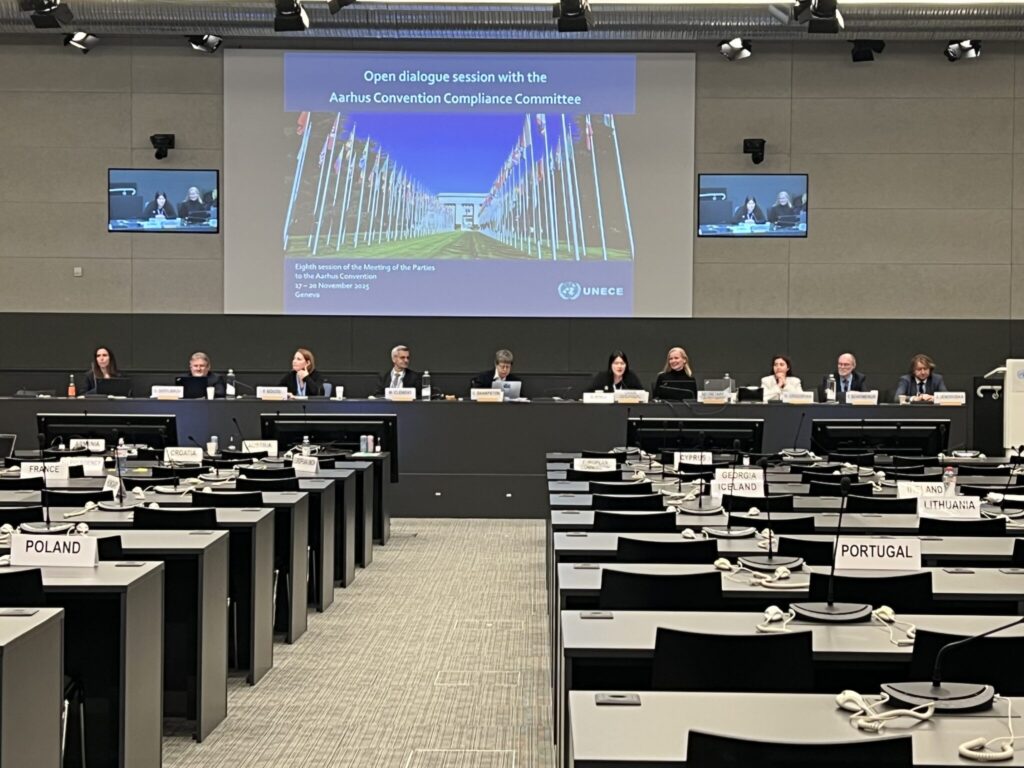
Photo from GNHRE
The UK Government’s refusal to endorse a UN decision requiring it to comply with an international Agreement called the Aarhus Convention raises serious questions about the UK’s commitment to the rule of law.
What is the Aarhus Convention?
The UNECE Aarhus Convention was signed in Aarhus, Denmark in 1998. The UK is one of 48 Parties and has, since its inception, contributed to the drafting and development of the Convention. The aim of the Convention is to ensure that everyone, regardless of social or economic status, is adequately equipped to protect the environment, by seeking to set minimum standards around access to information, public participation in decision-making and access to justice in environmental matters. More recently, Parties to the Convention (which included the UK) established additional protections for environmental defenders, to ensure that those exercising their rights under the Convention remain free from harassment, persecution and penalisation.
What happened in Geneva?
The Eighth Meeting of the Parties (MOP) to the Convention was held in Geneva this November. Prior to this meeting, UK had indicated that it would refuse to endorse findings by the Aarhus Convention Compliance Committee (ACCC), the body within the Convention responsible for reviewing and facilitating compliance. The findings criticised the UK’s failure to ensure the public is routinely consulted on draft legislation concerning the environment, in this case the EU Withdrawal Bill. But on the morning of the meeting, the Government stated it would also refuse to endorse findings concerning a long-running complaint on the prohibitively high costs of legal action. A state of affairs which means that access to justice in environmental matters is available only to the very wealthy.
Even more troubling, was the UK’s opening position that endorsement of all the Compliance Committee’s findings should be postponed until the next MOP in four years’ time. Had this proposal been accepted, it would have represented a significant and retrospective change of the rules of procedure of the Convention. Indeed, the UK position was met with surprise and consternation on the part of Switzerland, Norway and members of the Compliance Committee. Such was the magnitude of this proposal, that both the chair of the ACCC, Professor Áine Ryall, and Dame Eleanor Sharpston, current Committee member and former Advocate General of the Court of Justice of the European Union, felt compelled to make statements reminding all the Parties about fundamental commitments of the rule of law. As Dame Eleanor put it: ‘on an ordinary view of the rule of the law, you change the rules for the future, you do not retrofit them…’
Other troubling moments during the MOP included the EU’s attempt to elect a serving member of the European Commission to the Compliance Committee, a move that would have seriously undermined the independence of the Committee; the watering down of Decisions VIII/9 on promoting the effective protection of environmental defenders; and a general unwillingness to adequately fund the work of the Convention, meaning that only $20, 000 remains in the fund for 2026.
One bright moment from the MOP, however, was the re-election of Michel Forst to the post of UN Special Rapporteur on Environmental Defenders.
Why this matters?
Quite apart from the wider significance of the UK proposing retrospective changes to collective rules which govern procedures under the Convention, their refusal to endorse the findings of the Compliance Committee represents an unwillingness to hold themselves accountable to external and independent scrutiny. A pattern echoed in the ongoing discussion of whether the UK should leave the European Convention on Human Rights.
One of the most important features of the Aarhus Convention Compliance Committee is that it is a facilitative body, not a judicial one. Its findings represent a high quality and deeply considered analysis of Parties obligations under the Convention, and it aims to serve Parties as well as provide members of the public with a forum to consider perceived breaches of their rights under the Convention.
Whilst the UK is not the first Party to refuse to endorse the Conventions findings, in 2017 and again in 2021 the EU did so in relation to findings on their failure to provide access to justice under the Court of Justice of the European. Their refusal, as with the refusal of the UK, was met with disappointment on the part of other Parties and NGO observers. The Convention operates on a consensus basis, and unilateral moves such as those by the UK and EU, undermine this important commitment. But it also sends a troubling signal by these parties that they see themselves as beyond reproach, unwilling as they are to countenance the constructive insights of the expert and independent Compliance Committee.
Undermining Access to Environmental Justice
This UK’s conduct at the MOP highlights two troubling strands of thought in modern British politics. First, an unwillingness to accept the wisdom and value of scrutiny of government actions, whether that be via judicial review (JR) in national courts, or via external bodies like the Aarhus Convention Compliance Committee or the ECrtHR. Second, a rhetoric of “growth, growth, growth” regardless of the environmental and social costs. In support of these twin agendas, the Prime Minister even placed an article in the Daily Mail attacking a former Green Party councillor for bringing a JR of upgrades to the A47 earlier this year. Indeed, this article heralded a wave of negative rhetoric about the Convention.
While a recent Parliamentary Question appears to confirm the UK is not pulling out of the Convention, the refusal to accept the careful findings of the Convention’s compliance mechanism effectively means any action on costs could be postponed until after the next Meeting of the Parties in 2029, creating uncertainty and instability on the question of access to environmental justice in the UK.