March 8th, 2025
Women leading the way: How community activism saved St Austell Bay
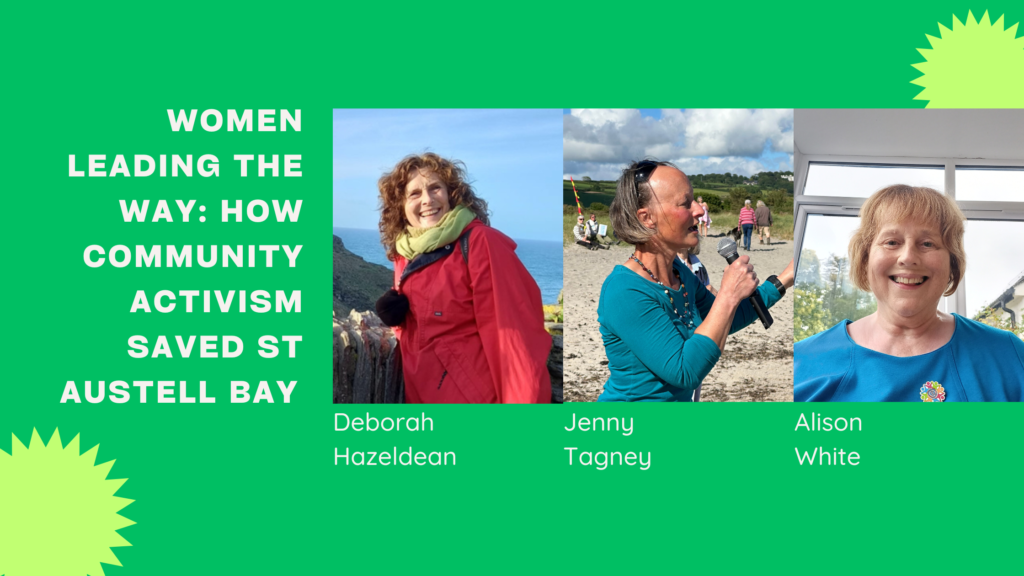
Environmental advocacy often begins with a single moment of realization—a spark of outrage or a deep sense of responsibility. For Jenny, Deborah, and Alison, that moment came when they learned of plans to install a desalination plant in St Austell Bay, a marine habitat teeming with seagrass, maerl, and vulnerable species. Their fight against this environmental threat, supported by the Environmental Law Foundation, led to a major victory: the refusal of a crucial licence for the plant. Their journey is a powerful testament to the impact of grassroots activism, community unity, and the leadership of women in environmental justice.
What inspired you to take action and become a leader in environmental advocacy within your community?
Deborah: When South West Water sent an assumptive letter to a handful of local householders and farmers stating they would be conducting surveys on their land in order to ‘progress’ a scheme to install a desalination plant in St Austell I was outraged. They were already polluting our rivers and seas with regular sewage outfalls and this scheme would clearly have a huge impact on the local marine and land environments. SWW’s complete failure to conduct any level of public consultation before sending out the letters suggested a lack of transparency and disregard for the local area that clearly needed to be rectified.
I didn’t set out to become a leader in environmental advocacy – I simply believed the local environment needed to be protected and the local community deserved to be informed.
There was no single inspirational moment to take action – what started over coffee with a small handful of other like-minded individuals took on its own momentum, driven by a collective sense of environmental injustice and opposition to SWW’s arrogant assertion that this project would ‘have little impact on either the environment or the local people.’
Jenny: Having grown up in a City, I now treasure living in Cornwall, on the South coast and take every opportunity to learn about this precious environment. Being able to walk out along coast paths and on beaches during the 2020 pandemic was a real privilege and helped us all turn back to nature for solace. This time reaffirmed the importance of our Local Nature Reserve environment and inspired me to re-double efforts to protect and enhance special marine and terrestrial environments.
Alison: Visiting the National Marine Aquarium at Plymouth and learning that seagrass plays a vital role in capturing blue carbon and preventing floods; and that a Desalination Plant in Par would threaten not only the marine environment but also potentially make the flooding worse for local residents.
What has been your proudest achievement or most meaningful moment in your journey to protect the environment?
Deborah: As a group we set out to research information about the effects of desalination in general and specifically, the likely environmental impact of SWW’s proposed plant at St Austell Bay. The local community were still largely unaware of the scheme and it was important that we shared our knowledge and findings.
With some trepidation we booked a local hall and advertised a formal presentation expecting just a handful of people to come.
That first meeting felt like a momentous achievement – the hall was full to capacity, standing room only, with a fully engaged audience. We were supported by the local broadcast and printed media, people donated money to our campaign and the evening gave us full confidence that what we were doing was of significant value not just to the environment, but to the local community.
I would also say that I am hugely proud of initiating and developing a relationship with ELF – the support we have experienced has been invaluable and much appreciated!
Jenny: Being a founding member of the Desalination Information Group has led to a local campaign that has inspired many people to take a renewed interest in their local environment and awakened a desire to protect it. Through public presentations, drop-in sessions, emails and social media we helped ensure the truth of the environmental impact was exposed. Garnering such public outcry in response to the environmental threat of a desalination plant and helping harness people’s outrage at the prospect of the destruction of protected marine habitat has been amazing. Helping to gather and lead over 300 people in a beach Show of Strength was a very proud moment indeed, as was the news that test drilling in the bay had been refused.
Alison: Realising that without acknowledging it in a formal sense on a conscious level, I have always been an environmentalist in my day-to-day living; and that now I am retired, I have the experience and skills to be able to contribute to protecting the environment by challenging those whose actions threaten it.
What challenges have you faced as a woman leader in environmental advocacy, and how have you overcome them?
Deborah: In all honesty I have never felt restricted by my gender. I’ve spent most of my working life running my own company and I have always been driven by carrying out work that I genuinely believed in. If you have a passion and conviction about what you’re doing what follows is simply ‘getting on with it’!
More by luck than intent, I have always worked with strong women and this has been true for our environmental campaign as well – we’ve overcome challenges as a team.
Jenny: I believe that environmental advocacy faces challenges whether championed by a woman or other genders. Environmentalists are often dismissed as `tree huggers’, and caring for the environment dismissed as standing in the way of progress/homes. However, researching the area in question, ensuring that you are equipped with scientific knowledge, facts, confidence in your arguments and a passion for your subject helps to ensure that people listen and pay attention when you put forward your objections to an environmental threat, rather than dismiss you.
How do you believe empowering women contributes to stronger, more resilient environmental movements?
Deborah: I truly believe women are great multi-taskers – anyone who has juggled a career, a home and a family has the ultimate training in managing a multitude of issues at any one time. Whilst an environmental movement may be directed towards a single outcome, there is no single route to achieve it and we need to fully embrace all skill sets to achieve the best results.
Jenny: I believe ensuring gender equality and enabling girls and women to have the same opportunities as boys and men is fundamental to the success of our society. Ensuring that everyone appreciates that we are all part of nature, rather than the exploiters of it could really help to shift the balance of power towards a `nature first’ shared goal.
What advice would you give to other women and girls who want to take action and become leaders in environmental justice?
Deborah: If the concept is true and just, follow your instinct and do what you believe is right. Be informed and prepared and don’t be afraid to stick your head up above the parapet!
Jenny: Just do it! Start finding out what is going on locally and find a cause that you feel strongly about. The rest will come as you collaborate and research your chosen field.
Alison: Find a cause you believe in!