February 2nd, 2025
The Return of the Wetlands: How Lewes reclaimed a lost habitat
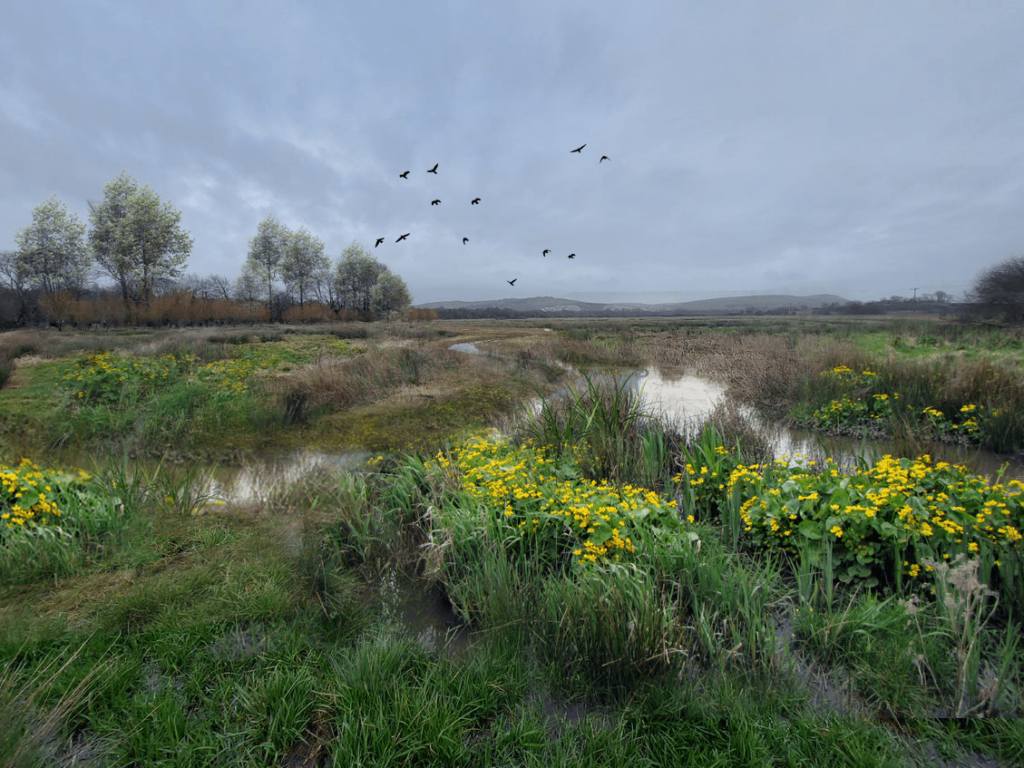
The Cockshut Stream Restoration Project
by Emma Montlake, ELF Co-director
For Wetlands, it is all in the name; land that is wet, land that is under water, land that is constrained by the controlling element of water and its effect on that land, by the coming and going of water, whether marine or freshwater, either permanently or seasonally. The associated plant and animal life adapted to life as semi aquatic and aquatic species.
The Ramsar Convention defines wetlands, under the Convention, Article 1.1, thus: “areas of marsh, fen, peatland or water, whether natural or artificial, permanent or temporary, with water that is static or flowing, fresh, brackish or salt, including areas of marine water the depth of which at low tide does not exceed six metres”.
The WWF estimates that globally we have lost a staggering 87% of our wetlands. These are essential habitats for many mammals and fish, the birds that return to feeding grounds that once existed, gone, extinguished by human activities, with draining and ditches that remove the water from the land, reclaimed land is valuable to humans. And we wonder where all our waders and water birds have gone…
So as usual when I can’t cope with the global, I look to the local where amidst this tale of lost habitats and species, I wanted to reflect on a local nature recovery initiative that has happened in my hometown of Lewes and how it has changed a community both human and non-human. In 2022 a planning application was submitted by Lewes District Council, in partnership with the South Downs National Park and the Ouse And Adur River’s Trust, for the creation of a new wetland habitat, for the re-wiggling of the Cockshut Stream, one of two chalk streams that run through Lewes. Straightened in decades past, concreted up, a flow to nowhere and a stagnation of water. Latterly parrots feather, a highly invasive pond plant had taken over and taken any light from the shallow depths below. The proposal was that the straight stream would be filled in but a new stream, taking old routes and water ways through the marshland that joined it up to other water courses, reinstating the flow of the stream and its inherent right to flow. As it once had. Joining the flow in to a new flow to a large shallow lake. A wetland in Lewes.
At the time, the planning application was controversial, many local people were worried. I like many walked my dogs over the marshland, loved it, along the straightened cockshut, and wider to a marsh, full of ditches dug long ago, reeds and marsh plants, a bit of wild in another wise central formal green space offering. It was a great space for invertebrates, spiders and crickets, the marsh frogs giving a vivid green voice to spring and the reed warblers an ever summer presence. And once some rare snails now long gone, for which it had been designed a SSSI.
When the application was approved what followed after the environmental archaeologists had been, was utter destruction, local people lost confidence in what was taking place to a cherished place. Eight huge bulldozers appeared, to dig out all the new water channels, the shallow lake dug and the straight-line cockshut we knew of old, filled in. Bridges were constructed. It was months of slow heavy mud reconstruction but slowly shape appeared, the new water ways, the lake filled up quickly. The public were asked to keep out whilst the seeding set. And finally with no fan fare and much trepidation by the Council, it was opened to the public a year after it had been reimagined. A wetland in Lewes.
But before it opened to the public it opened to nature, immediately and nature came back in its droves. Waders appeared at the banks of the lake, a marsh harrier spotted, great white storks, shovelers and other wildfowl, flocks of grey wagtails and goldfinch. The eels came back. And the marsh frogs that we worried were lost. Though an invader from Hungary they were much loved. Dragonflies on a day, there were so many you couldn’t count, the barn owl and the kingfisher. I have seen it all. For a while it was a swan takeover – 27 at one count. The non-human community was clearly delighted.
And what happen to the human community, was also one of delight and wonder. In the summer when the banks of wild carrot were so high you couldn’t see the lake, I had so many joyful conversations with people about the nature there in all its forms, what we’d seen and heard, nature stories shared. A rare space has been created, giving space to nature, where nature thrives and a space where a commune with nature for local people, to be in nature’s space and what that feels like. We are asked to be respectful, us humans, keep dogs on the lead, and most do. There are responsibilities for us that go along with the rights of the new wetland to thrive.
The project has won two awards and https://www.lewes-eastbourne.gov.uk/article/2924/Cockshut-Restoration-is-double-award-winner I will leave you with an extract from the Cockshut Restoration project website https://www.cockshutstream.org/
The Cockshut Stream Restoration Project is set to not only enhance biodiversity, help with flood management and carbon storage but also to restore the rights of the stream to flow unimpeded, unpolluted and with its native plants and wildlife protected.